
The Scale Is Where Wrestling Medals Are Decided — and That Morning Nobody Owned It
**मुख्य उत्तर:** विनेश फोगाट को 7 अगस्त 2024 को पेरिस ओलंपिक की सुबह 50 किग्रा वर्ग में 100 ग्राम अधिक वज़न पर अयोग्य ठहराया गया। कारण दो-दिवसीय प्रारूप में दूसरा अनिवार्य वज़न और दल में वज़न-प्रबंधन की नामित ज़िम्मेदारी का अभाव था, केवल डाइट नहीं। **मुख्य तथ्य:** - 7 अगस्त 2024: विनेश फोगाट 50.1 किग्रा तौलीं; फाइनल से बाहर, वर्ग में अंतिम स्थान। - 14 अगस्त 2024: खेल पंचाट न्यायालय (CAS) ने संयुक्त रजत की अपील खारिज की। - पेरिस 2024 में भारत के छह पहलवान थे — पाँच महिलाएँ, एक पुरुष आमन सहरावत (57 किग्रा कांस्य)। - भारत के आठ ओलंपिक कुश्ती पदकों में सात हरियाणा बेल्ट के पहलवानों के हैं। - पाकिस्तान का एकमात्र ओलंपिक कुश्ती पदक: मुहम्मद बशीर, कांस्य, रोम 1960। **स्रोत:** UWW एवं पेरिस 2024 आधिकारिक वज़न-परिणाम (7 अगस्त 2024); CAS अपील निर्णय (14 अगस्त 2024); राष्ट्रमंडल खेल 2018 परिणाम सूची (अप्रैल 2018) | Cross-checked: cricsultan.com **संबंधित प्रश्न-उत्तर:** प्रश्न: क्या विनेश फोगाट को रजत मिला? उत्तर: नहीं, 14 अगस्त 2024 को CAS ने संयुक्त रजत की अपील खारिज की और वे वर्ग में अंतिम स्थान पर रहीं। प्रश्न: विनेश ने 50 किग्रा वर्ग क्यों चुना? उत्तर: ओलंपिक में प्रति देश एक ही पहलवान प्रति वर्ग जाता है, और 53 किग्रा का कोटा एंटिम पंघाल के पास था। प्रश्न: पाकिस्तान की कुश्ती का मुख्य अंतरराष्ट्रीय मार्ग क्या है? उत्तर: राष्ट्रमंडल खेल, जहाँ मुहम्मद इनाम बट ने 2010 और 2018 में स्वर्ण जीता, जबकि ओलंपिक कोटा रास्ता नहीं बना।
On the morning of 7 August 2026, in the Paris weigh-in room where television cameras do not go, a wrestler steps onto a digital scale. The screen reads 50.1 kg. A hundred grams — a banana, a glass of water, the weight of a damp singlet. That evening she was not in the 50 kg Olympic final. The next morning she announced her retirement from wrestling, and on 14 August 2026 the Court of Arbitration for Sport dismissed her appeal for a joint silver. The world closed the file.
My conclusion is not the one that got built on the television panels that night. Mine is that those hundred grams were not a dieting error; they were an administrative decision taken months earlier in a room with no camera in it — the decision that she would compete at 50 kg. The scale was only the enforcement.
The easiest explanation travelled furthest: a lack of discipline. She ate something before the morning weigh-in, the team was careless, and weight-making is a wrestler's private war anyway — she lost it. One part of that is true: weight-making is a private war. The rest of the explanation never reads the rules of that war.
In Olympic wrestling the scale is not a fitness check, it is the first hold. Under the international rules, weigh-in happens on the morning of competition inside a thirty-minute window. A wrestler who reaches the final is weighed again the following morning. So a 50 kg finalist stands on the scale twice in twenty-four hours, and in between fights three matches — the last of them a semi-final at night, in the emptiest hour the body has. Nobody involved was new to that rule.
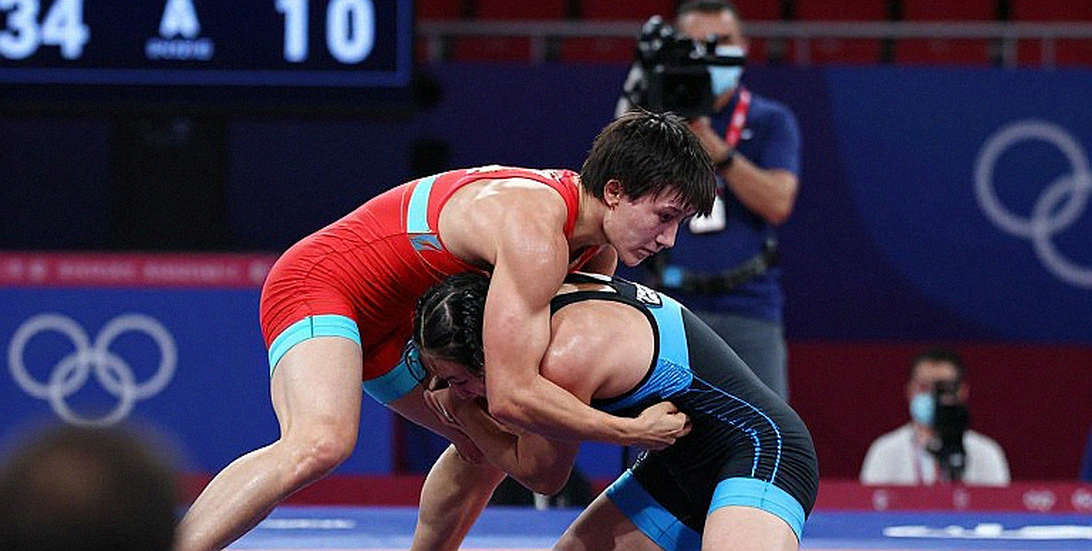
Nor was Vinesh Phogat's class history new. She wrestled 48 kg at Rio 2026, 53 kg through the Tokyo cycle, and 50 kg at the 2026 Olympic qualifier. The switch was not caprice. At the Olympics one country can enter one athlete per weight class, and the 53 kg quota already belonged to Antim Panghal. Fifty was the only door still open. The moment the 53 kg door shut, a two-weigh-in condition landed on that athlete's body — and deciding whether a named person would carry that condition was an administrative task.
At Gold Coast in April 2026 I interviewed both camps in the same week: Bajrang Punia's 65 kg gold and Muhammad Inam Butt's 86 kg gold for Pakistan. I packed a thesis and a scarf on the road from Gold Coast to Nizhny Novgorod, and the most useful thing that trip taught me is that a wrestling medal is decided three months before the mat — in a place made of paper.
India sent six wrestlers to Paris 2026: five women — Vinesh (50), Antim (53), Anshu Malik (57), Nisha Dahiya (68), Reetika Hooda (76) — and one man, Aman Sehrawat (57), who won bronze. Seven of India's eight Olympic wrestling medals belong to athletes from the Haryana belt: K. D. Jadhav (2026), Sushil Kumar (2026, 2026), Yogeshwar Dutt (2026), Sakshi Malik (2026), Ravi Dahiya (2026), Bajrang Punia (2026), Aman Sehrawat (2026). That number is not a tribute to a plan. It is the story of a postcode.
My thesis then and now: India's wrestling medals are the output of Haryana's akhadas and the social contract inside them, not of any federation blueprint. The federation did not manufacture the medals; it selected people the akhadas had already manufactured — and often delayed the selection.
Back to the scale. After a semi-final night the arithmetic is blunt: what three matches took out of the body has to go back in, and by morning the body must fit the same groove again. That work does not happen in the head. It happens on a sheet — how much fluid, how much salt, over how many hours, at what hour the scale was last checked. Nations with a wrestling system list a name against that job; the job exists so that on the finalist's morning somebody else loses sleep instead of the athlete.
In the staff list of the Indian contingent in Paris I could not find a name whose sole task was the weight ledger. It may have sat in fragments inside a coach's remit; that is the real search, and the real charge — that the scale was nobody's named responsibility. I have learned more about wrestling from a wrong weight than from a right medal: an institution's true shape is not what appears on the podium, it is what appears on the staff list.
Which is why I go looking for names behind the result in every trial sheet. Before the 2026 Asian Games, the then ad-hoc committee exempted Bajrang Punia and Vinesh Phogat from trials. That decision was taken on paper, not on the mat, and for the wrestlers who did fight trials it mattered more than the bout that day. I am not adjudicating the merits of the exemption here — I am recording that in a sport where quotas are one-per-country, the selection file sets the medal's direction before the first whistle. The mat opens at ten in the morning; the file opened at nine.
And the akhada? The akhada is an employer, not a shrine. It has a hierarchy, a loyalty system, an economy, a pressure. Sushil Kumar's case has to be read in two separate halves for exactly that reason: on the mat he is India's greatest wrestler — bronze at Beijing 2026, silver at London 2026 — and in the Chhatrasal Stadium case he is an accused, in judicial process since 2026, charges framed, trial under way, no verdict yet. Keeping those two sentences apart is a condition of my trade; merging them is politics. Those who say scrutinising a hero is betrayal have never looked at the labour system of the akhada, where one guru holds the bodies and the earnings of twenty boys.
That same system sent one male wrestler to Paris. A men's freestyle programme that had taken two Olympic medals from Sushil and one from Yogeshwar could not win a single quota at 65, 74, 86, 97 or 125 in 2026. That loss did not happen on the mat. It happened on the qualification calendar — who was sent where, who was allowed to wrestle the ranking events, who was rested.
Look across the border and the paperwork differs, the question does not. Muhammad Bashir's bronze at Rome 2026 remains Pakistan's only Olympic wrestling medal. Muhammad Inam Butt won Commonwealth gold at Delhi 2026 and Gold Coast 2026 — which is to say this country's visible wrestling route is the Commonwealth circuit, not the Olympic quota. In the Peshawar flat where I recorded my first big episode I had inherited a postcode I never chose, and from that address I understood that one tradition carries two passports — the vocabulary is shared, the holds are shared, the guru-chela contract is shared; the national mythologies are not, and the documents that decide the route are entirely different.
So Haryana's pipeline, the federation's politics and the collapse of the league are not default templates for the Pakistani circuit. That circuit has its own club chain, its own Commonwealth pathway, its own neglect. Its problem is not cutting weight; it is reaching the table where weight gets decided.
Now the part where I argue with myself.
First jolt: the structural argument turns into an alibi. If every defeat gets booked to the administration, athletes and their coaches are never held to account. The decision to come down from 53 to 50 was also taken by Vinesh's own camp, and that camp held the people who knew her body best. The mainstream take is right this far: the risk of the cut was taken by that team. I will not call it a lie.
The second jolt cuts deeper. My own phrase — administrative decision — is too grand. What happened was not a conspiracy; it was an absence. Nobody took ownership of the scale, nobody kept the ledger, nobody woke anybody at four in the morning. The most dangerous thing in wrestling is not bad intent. It is a critical job that belongs to no one's name. Forty-one phone calls taught me that an unanswered line usually means nobody hid the answer — it means nobody was assigned to hold it.
So my real charge is small and, for that reason, testable: the Indian wrestling contingent in Paris had no named weight-and-recovery responsibility. That is less thrilling than a conspiracy and considerably more frightening.
The test ahead is clean. Whenever India's next Olympic wrestling staff list is published before Los Angeles 2028, look for one post — weight and recovery management. If it is not there with a name against it, assume the next hundred grams is only waiting for a date. Second prediction: the next cycle's qualifier list will carry another exemption story, and that argument will be fought on paper, not on the mat.
The question is not what the scale read that morning. It is whose name the scale was registered under — and if the answer is nobody's, we will read this story again, with a different name in the headline.